
AI and Your Career: The Opportunity Inside Your Job

Jay Vergara 8 min read
- AI tools
- L&D
- Leadership
Most of the advice about AI and your career right now pushes people into one of two camps. Camp one gets told by YouTube to quit and start an AI automation agency. Camp two is senior in their field and pretty much frozen, because they’re convinced AI will make them irrelevant within the next 18 months. I think both camps are reading the data a little wrong, especially if you work in HR, learning and development, consulting or finance.
The video is on YouTube, and this is the written version of it.

It started as a reply to Nate Herk’s video about the AI career opportunity in 2026. I think he’s about 80% right. The 20% he missed is the part that matters most if your job sits in a people function, so that’s what I want to get into here.
What the IBM data says about AI and your career
In May, IBM’s Institute for Business Value published its 2026 CEO Study. They surveyed 2,000 CEOs and senior leaders across 33 geographies between February and April 2026. Two findings stood out to me.
The first is the chief AI officer:
76%
of the organizations in IBM’s study now have a chief AI officer, up from 26% in 2025
In about a year, the share of organizations in the study with a chief AI officer jumped 50 points.
The second is about skills. 86% of the CEOs believe their employees have the skills to work with AI. The same CEOs say only 25% of their workforce uses AI regularly as part of their job.
That’s a 61-point gap between what leadership assumes and what’s happening on the floor, and I think it’s the structural fact of the next couple of years. The fear in most offices is that AI is coming for your job. What I see in this data is leadership assuming the skills are already there while most people haven’t really started. Sooner or later, companies are going to find out who actually has those skills.
Why the agency route is a tougher bet than it looks
Nate’s right that an agency is harder than YouTube makes it sound. Market saturation is part of it, but I think the bigger reason is that companies don’t need more outside AI vendors pitching them. They need more people on the inside who get AI and know how to use it in the actual work.
That’s how I understand the chief AI officer trend. It’s mostly about reorganizing the functions a company already has, and much less about hiring outside firms. The same IBM study found that 85% of respondents say every functional leader has to become a technology expert in their own domain. In other words, they want the people they already employ to get fluent with AI inside the jobs they already have.
So the opportunity is sitting in the building you already work in.
Rebuild one workflow and write down what broke
What do you do with that? The move isn’t glamorous. Pick one workflow in your current job. Pick something repetitive with a clear before and after, the kind of task where you’d know right away if the new version is better.
Then rebuild it with the AI tools you have. I talk about Claude (Anthropic’s AI assistant) a lot, but use what you’ve got, whether that’s ChatGPT or Microsoft Copilot. It’s fine if the tool sits a little outside your comfort zone, that’s sort of the point.
Then write up what broke.
- Pick one workflow Something repetitive in your current job, with a clear before and after.
- Rebuild it with AI Use the tool you already have, whether that’s Claude, ChatGPT or Microsoft Copilot.
- Write down what broke What failed, what worked, and what you had to redesign along the way.
That last step is what sets you apart. Everyone is going to say they use AI, or that they’re an AI expert. I’m kind of guilty of that myself, since I run a YouTube channel about it. Far fewer people can tell you what failed, what worked, what didn’t, and what they had to redesign along the way. That’s what fluency looks like, and it’s what the people doing the hiring are starting to look for.
The AI skills employers want now
Job postings have already started to change. In finance, Datarails looked at more than 5,000 US job postings and found that 31% mentioned AI or machine learning in January 2026, up from 25% a year earlier. (In the video I quoted a rougher number. This is the sourced one.)
The wording is shifting as well. Lines like “comfortable with Excel” are giving way to things like “can validate AI output” and “can deploy AI tools in a workflow.” That’s the new vocabulary, and the people who pick up on it early are the ones getting the interviews and getting into the room. Look at a few postings in your own field this week and count how often it shows up.
Your one-workflow project fits that language pretty well. You checked what the AI produced, you put a tool into a real workflow, and you can explain what happened when it went wrong.
My own AI setup in learning and development
I want to show my version, because I think it matters that this isn’t theoretical. I’ve worked in learning and development for more than ten years (I don’t even remember exactly), I’ve done consulting on top of that, and I’m working on an MBA.
Over the last six months I built workflows in Claude Cowork, Anthropic’s desktop app where Claude can work with your files and tools. They’re connected to my Notion library, my Google Calendar, Consensus (a search engine for research papers) and Apify (a web scraping tool). All of it is linked through MCP, the Model Context Protocol, which is a standard way to plug outside tools into an AI assistant. I didn’t write any code to set it up.
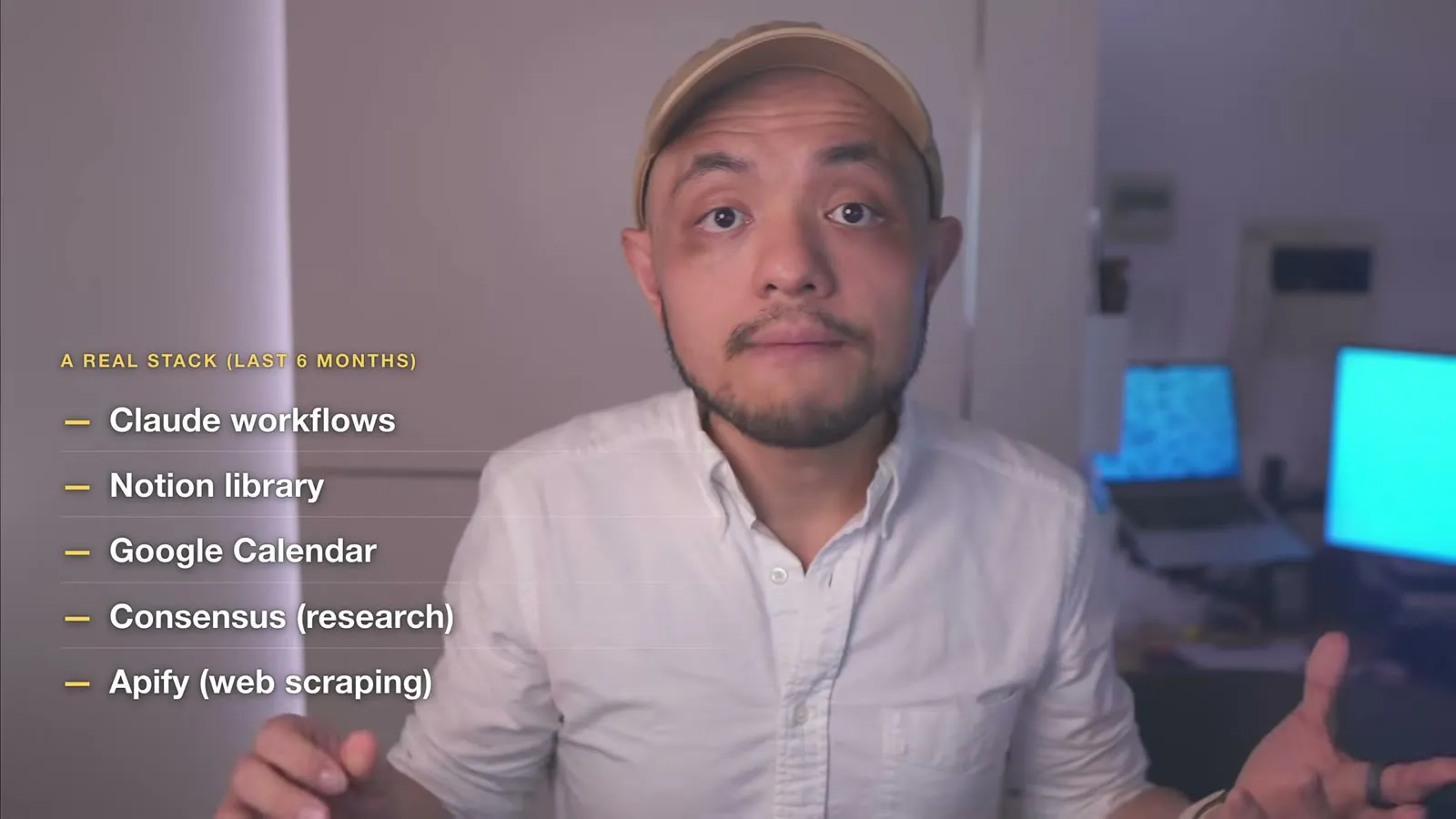
The stack isn’t really the point, though. Nothing on that list is out of reach for someone in L&D, HR or marketing. The tools are sitting there, and the skills compound once you start using them on your real work.
Why the next 18 months matter
I have a theory that the next 10 years of careers will be decided in the next 18 months or so. I don’t think the people who come out ahead will be the ones switching industries. I think it’ll be the people who picked a depth and got really fluent inside it.
While everyone else chases the agency dream or hides from the technology, the chief AI officer at your company probably won’t be hired from outside. My bet is it’ll be someone already there, who understood a function and got fluent with AI. That person could be you.
I added the L&D and HR layer because that’s the lane I work in, but it doesn’t have to be L&D or HR. Whatever function you’re in right now, connect your domain experience with real AI fluency and you’ll be in a good spot.
Which workflow would you rebuild first? Tell me in the comments on the video, or come find me on LinkedIn.
More videos on the leadhuman.ai YouTube channel.
Subscribe on YouTubeSources

Jay Vergara lives in Tokyo and builds things with AI. He writes about what he learns at leadhuman.ai, makes videos about it on YouTube, and posts on LinkedIn. Most of his career has been in learning and development (L&D) and training.
You might also like

AI Layoffs Statistics 2026: Why 9% and 31% Both Matter
Two AI layoffs statistics seem to clash: 9% would replace everyone with AI, while 31% of service leaders are cutting roles. What the gap means for your job.

What Is AI Fluency? Four Skills You Can Actually Train
What is AI fluency? Four skills you can see and train: delegation, description, discernment and diligence. Most AI training stops at awareness.

AI Adoption Mostly Comes Down to Whether You've Made It Safe to Try
AI adoption isn't stalling because employees fear technology. It's stalling because manager engagement has collapsed and your team is reading the room.