
What Is AI Fluency? Four Skills You Can Actually Train

Jay Vergara 7 min read
- AI tools
- L&D
- Leadership
Recently I read a post on r/artificialintelligence from a learning and development manager. Her senior leader had made AI fluency a top priority for 2026, and when she asked what that actually meant, they couldn’t tell her. They wanted it, they just couldn’t describe it. So she was left building a training program around a question nobody above her could answer: what is AI fluency?
I don’t think she’s alone. Over the last six months I’ve heard some version of that conversation at maybe 20 companies, and every time it’s the person on the receiving end who has to make sense of a directive with no definition behind it. AI fluency is a lot more concrete than those conversations make it sound, though. There’s a real framework you can build a program on, and it helps whether you got handed the directive, you’re the leader who said the word, or you’re just trying to figure out where you stand.
I talked this through in a video on YouTube, and this is the written version.
Why AI fluency sounds so vague
I think fluency feels squishy because most leaders mix it up with awareness. Awareness is knowing what ChatGPT is. It’s having watched a webinar about it, and being able to write a prompt that gets you a usable answer.
That’s where most corporate AI training stops, which is fine if awareness is what you wanted. Fluency is something else. You can break it down into specific behaviors that you can observe and teach.
What is AI fluency? The four skills
The framework I keep coming back to comes from Anthropic Academy, the free learning site from Anthropic (the company behind the Claude AI assistant). Its AI Fluency course was built with two professors, Rick Dakan at Ringling College and Joseph Feller at University College Cork, and their framework defines AI fluency as working with AI in ways that are effective, efficient, ethical and safe.
They break it into four competencies, the 4Ds: Delegation, Description, Discernment and Diligence. What I like about it is how practical it is. You can train each one, and you can see each one in the way someone works.
- Delegation Deciding what to hand to AI, what to keep for yourself, and whether to bring AI in at all.
- Description Telling AI clearly what you want and why: the content, the context, your intent and your constraints.
- Discernment Knowing when the output is right, when it’s wrong, and when it’s plausibly wrong.
- Diligence Owning AI-assisted work as your own, because it goes out under your name.
Delegation: deciding what goes to AI
Delegation is the judgment about what to hand to AI and what to keep for yourself. The framework describes it as setting goals and deciding whether, when and how to bring AI in at all. A fluent person knows which parts of their job AI does well, which parts it does badly, and which parts should never leave their own head.
That judgment doesn’t come naturally. It comes from experimenting, and sometimes from getting burned a few times, until you build up a feel for it.
Description: prompting is a communication skill
Description is being able to tell AI clearly what you want and why. It’s the part most people call prompt engineering, and I’d push back on that label because it makes a communication skill sound technical. The fluent people I know can describe the content, the context, their intent and their constraints in plain language.
If you think about it, that’s a leadership skill. Bad delegation to people looks a lot like a bad description to AI. If you’ve ever handed someone a two-line request and gotten back the wrong thing, you already know how this goes.
Discernment: catching the confident wrong answer
Discernment is looking at what AI gives you and knowing when it’s right, when it’s wrong, and when it’s plausibly wrong. That last one is the dangerous middle, because the answer sounds sure of itself and mostly checks out.
A fluent person catches it right away while someone who’s still building fluency ships it.
I think most training programs ignore this one completely.

Diligence: owning what you send
Diligence is owning AI-assisted work as your own. You can’t blame the model for what you sent. The output goes out under your name, in your voice, with your professional reputation behind it.
Fluent people treat AI like a junior teammate whose work they review before it leaves the building. That review is real work, and most AI rollouts never budget for it. The people who skip that review are the ones who end up as cautionary tales.
AI fluency needs the right conditions
The 4Ds are the building blocks, but they don’t grow on their own. They need the right environment, and building that environment is a leadership question, not an AI question. A few of the conditions that matter, as I put them on screen:
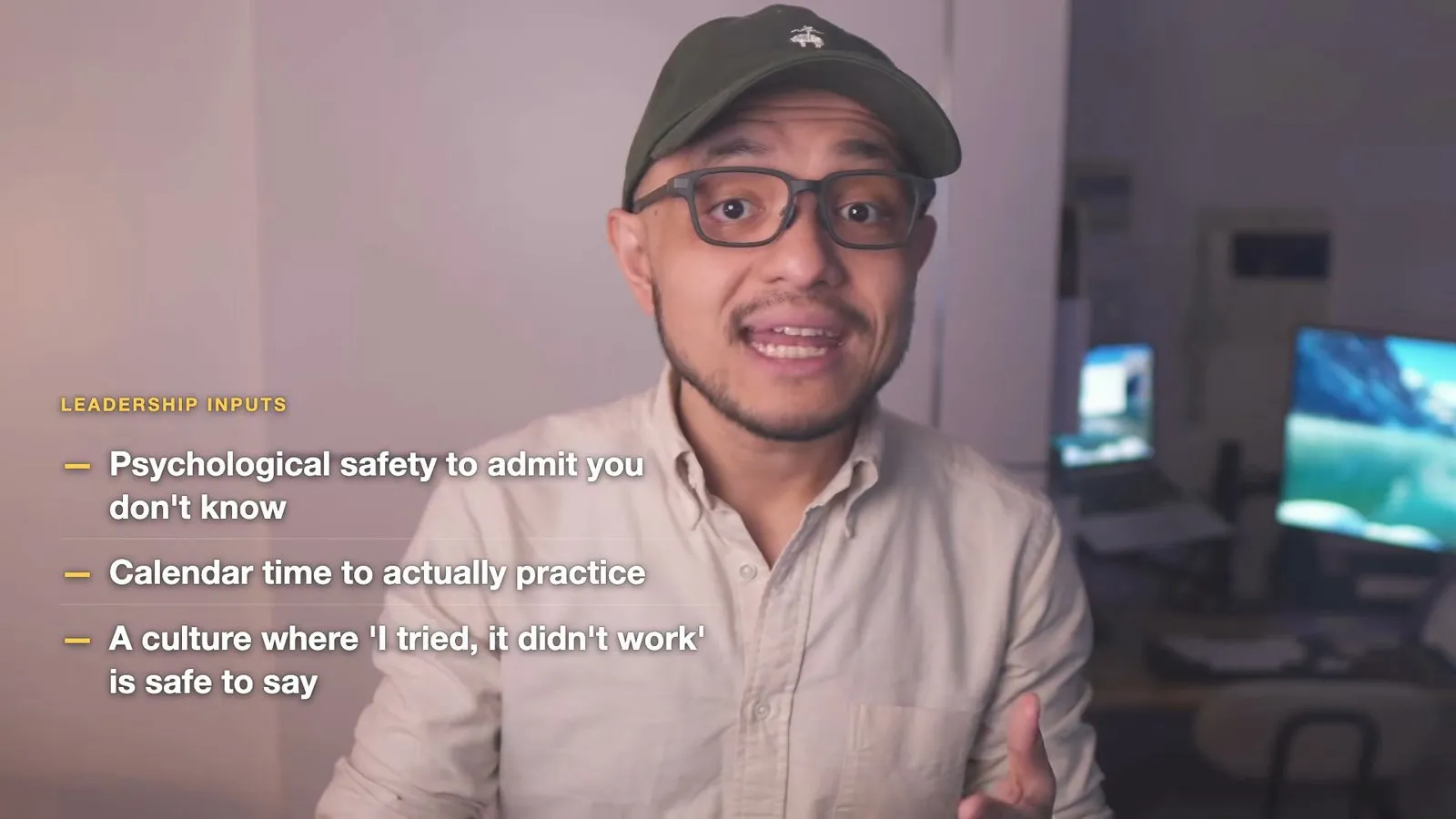
Those are leadership inputs, and the four Ds are what follows when the inputs are in place. When they’re missing, people hide their AI use instead.
The line I’ve been building leadhuman.ai around says the same thing: lead humanly, learn constantly, build with AI. Lead humanly is the conditions, learn constantly is the willingness, and build with AI is the practice. You need all three working together. Without them you get about as much fluency as a checkbox course gives you.
How to check your own AI fluency skills this week
Anthropic Academy’s AI Fluency course is free, so start there and use the 4Ds to see where you actually stand. Then ask yourself three questions:
- Where am I strong on each D right now?
- Where am I weak?
- What can I do this week to get better at the weakest one?
That gives you something specific to work on, which is a lot more useful than another vague directive about getting better with AI. If you want a bigger project to practice on, try rebuilding one workflow in your current job and writing down what broke.
If you lead a team, add one more. Are you building the conditions that let people develop these four skills, or are you using the word fluency as a wish?
And this goes beyond work. The 4Ds apply to anything you use AI for, whether that’s planning a trip, writing a hard message to a friend or figuring something out in your own life. The fluency you build at the office is the same skill in a different setting.
If you try the self-check, I’d like to hear which D came out weakest for you. Leave a comment on the video or message me on LinkedIn.
More videos on the leadhuman.ai YouTube channel.
Subscribe on YouTubeSources

Jay Vergara lives in Tokyo and builds things with AI. He writes about what he learns at leadhuman.ai, makes videos about it on YouTube, and posts on LinkedIn. Most of his career has been in learning and development (L&D) and training.
You might also like

AI and Your Career: The Opportunity Inside Your Job
AI and your career, through IBM's 2026 CEO Study: the 61-point gap, the AI skills employers want now, and one workflow you can start rebuilding this week.

AI Layoffs Statistics 2026: Why 9% and 31% Both Matter
Two AI layoffs statistics seem to clash: 9% would replace everyone with AI, while 31% of service leaders are cutting roles. What the gap means for your job.

AI Adoption Mostly Comes Down to Whether You've Made It Safe to Try
AI adoption isn't stalling because employees fear technology. It's stalling because manager engagement has collapsed and your team is reading the room.