
What Is Hermes Agent? The Plain English Version

Jay Vergara 10 min read
- Hermes Agent
- AI agents
- Nous Research
- Self-hosting
- Telegram
- AI tools
Everyone and their grandmother is installing Hermes Agent this month, and most of the videos explaining it assume you already know what an AI agent is. So I made the plain English version. For a lot of people watching those tutorials, my answer to “should I run it?” is “not yet,” and they’re about to lose a whole weekend finding that out. For me, though, it’s the most powerful thing I’ve ever played with.
The video is on YouTube, and this is the written version.

What is Hermes Agent?
Hermes Agent is an open source AI agent made by Nous Research, an AI research lab. An AI agent is an AI that can do things for you, like run commands, read files or send messages, instead of only answering in a chat window.
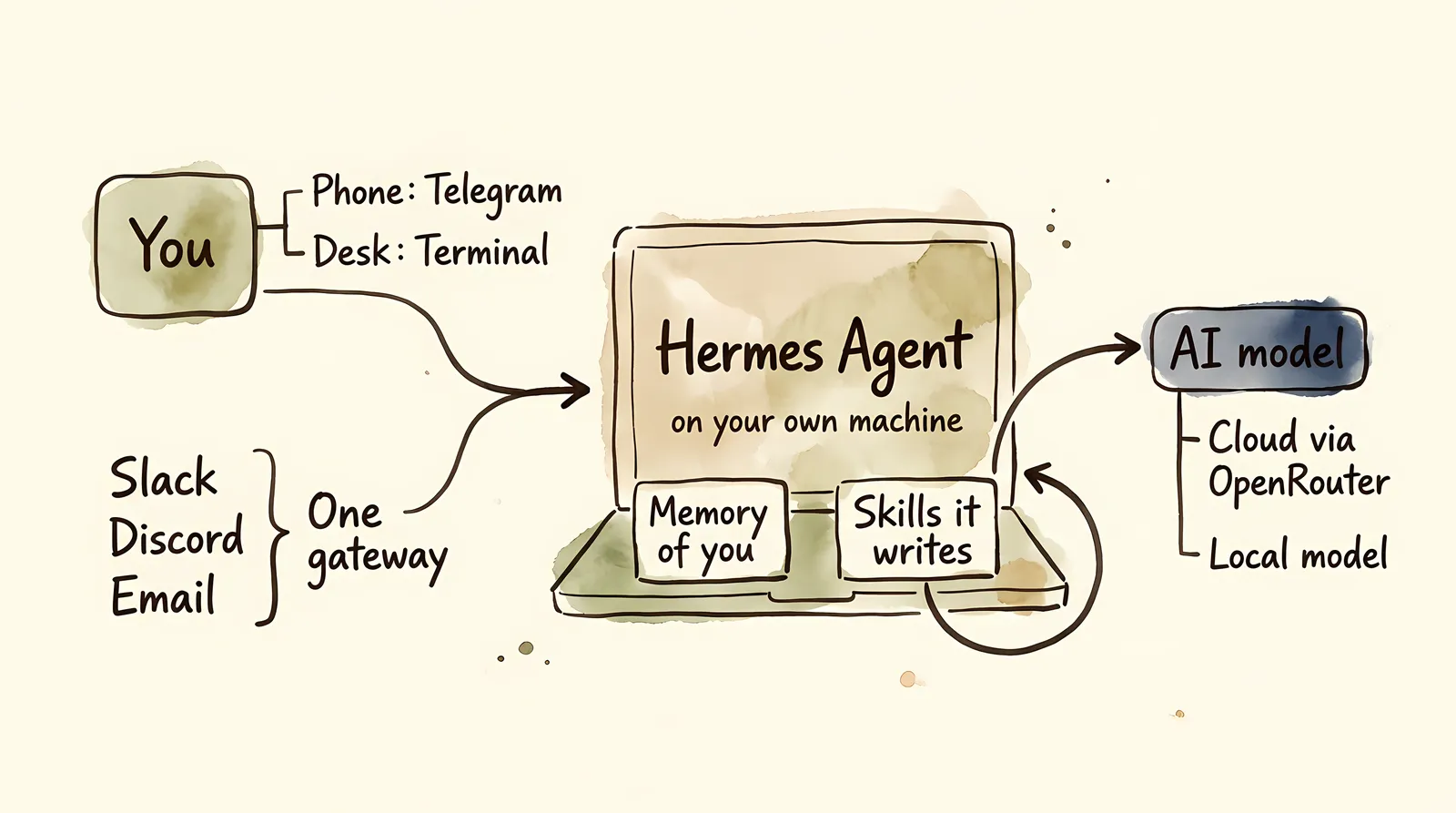
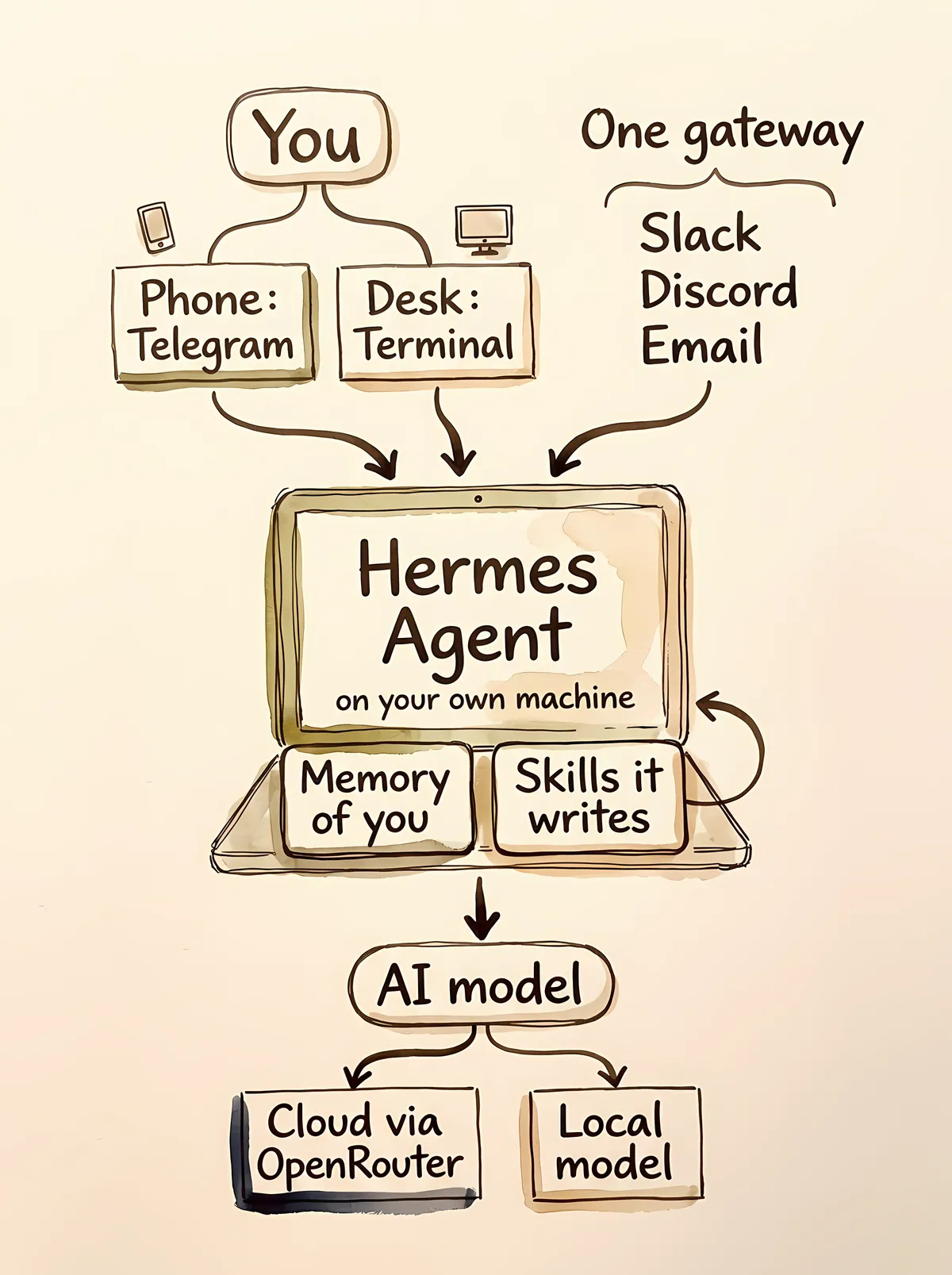
What makes Hermes unusual is where it lives. It runs on your own computer or server instead of someone else’s cloud. Mine lives on a MacBook Air, doing its thing in the background. The code is free on GitHub under the MIT license, and the official docs are at hermes-agent.nousresearch.com.
This is the whole setup on one page:
How Hermes Agent is different from ChatGPT or Claude
Four things set it apart from ChatGPT or Claude on the web.
| Feature | ChatGPT or Claude on the web | Hermes Agent |
|---|---|---|
| Memory | Starts fresh unless you set up memory yourself | Remembers you by default |
| Skills files | You write them | Writes and improves its own |
| Where you reach it | Their own app | Telegram, Slack, Discord, email, terminal |
| Where it runs | Someone else’s cloud | Your own computer or server |
It remembers you by default
Close ChatGPT and come back tomorrow, and it has no idea who you are unless you’ve set up a memory feature yourself. You can do that with Claude too, but you have to build it (this is how I set mine up). Hermes remembers by default. Each conversation builds on the last one, and over the weeks it builds up a model of you: how you write, what your projects are, and which requests are normal for you and which ones are weird.
It writes its own skills files
This is my favorite part. A skills file is a plain text instruction sheet that teaches an AI how to do one specific job. When Hermes works out how to solve a problem, it writes the solution down as a skills file and saves it. The next time something similar comes up, it pulls that skill out and starts from what it learned last time instead of from zero. This is how I put it in the video:
Hermes actually just creates it for you and it evolves by itself. That’s pretty wild.
I’ve talked a lot about writing skills files for Claude, like the ones behind my council of AI advisors. Hermes writes them for you and keeps improving them as it uses them, which still feels wild to me. The files follow the open Agent Skills format, so they aren’t locked inside Hermes.
It shows up wherever you already work
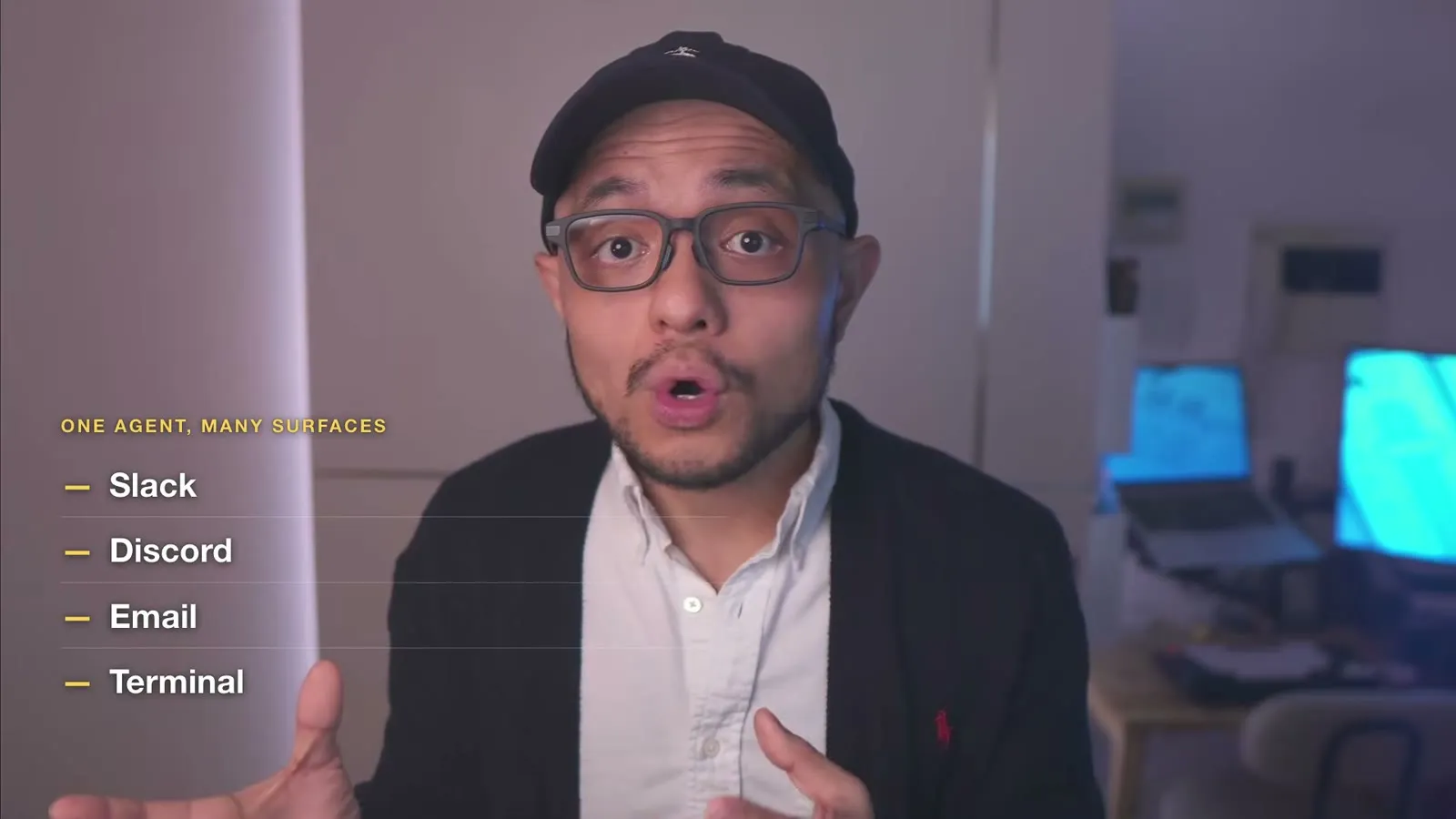
Hermes can sit in your Slack, your Discord, your email and a terminal window all at the same time. It’s one agent with a lot of ways in. When I’m at the computer I talk to it in the terminal, and on my phone I use Telegram. So when I’m on the train here in Tokyo and want to vibe code something, pull up some files or look something up in my Notion, I message it on Telegram. Most other tools make you go through their own app, and Hermes comes to wherever you already are.
Hermes Agent vs OpenClaw, Claude Code and ChatGPT
Hermes competes most directly with OpenClaw, another open source agent. If you stretch the definition a little, it’s also up against Claude Code (Anthropic’s agent that works inside the files on your computer) and ChatGPT’s agent mode, the feature that used to be called Operator.
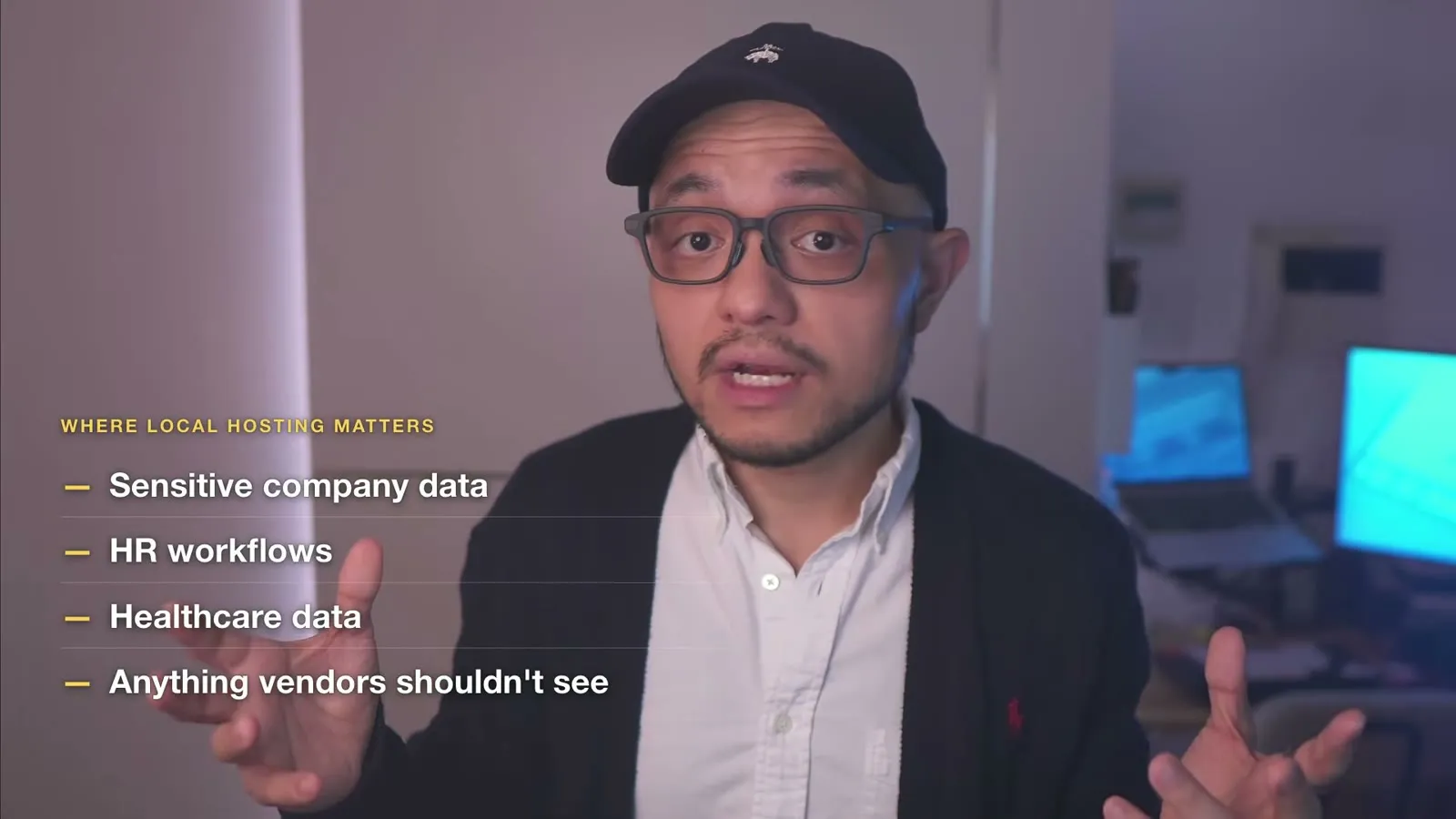
The big difference is that Hermes is open source and you run it on your own hardware. In theory your data never has to leave the building, as long as the AI model also runs locally, for example a DeepSeek or Qwen model on a powerful computer. That matters if you work with sensitive data, or if you’re brave enough to try this in HR, healthcare or anywhere else that cares about what gets sent to a vendor. You get an agent that’s with you everywhere and still runs on a private machine, and that part blows my mind.
The trade-offs
There’s no free lunch here.
- It needs a machine that’s always on. You host it yourself, and my MacBook Air is now basically a dedicated Hermes machine.
- You keep it patched. Updates are your job.
- The first install takes a few hours. Expect a bit of a rigmarole.
- It isn’t free to run. More on cost below.
- It acts on its own. That means it can do things you didn’t want it to do, so set boundaries before you give it real access. Hermes has some built in. Its security docs say it asks before running risky commands and refuses messages from anyone you haven’t approved.
The hardware and models I use
My MacBook Air was lying around and I wasn’t using it, and it’s plenty for my case. I connect Hermes to OpenRouter, a service that gives you one account for lots of AI models, and it picks the right model for the job, whether that’s DeepSeek, Anthropic or something else.
If you want to try Hermes, I’d do the same. Don’t go buy a Mac Mini with 128GB of unified memory, because if you’re reading this, you don’t need one. Use the old laptop you already have.
Once it’s running, the cost depends on which model you point it at. Point it at Claude or ChatGPT through their APIs and you pay per request, so the bill grows the more you use it. Running a model like Qwen or DeepSeek locally avoids that, but you need serious hardware, and a Mac Mini that can handle it runs around six grand.
Who should run Hermes Agent now
First, check your company’s security rules. An open source agent that acts on its own can be risky, and plenty of companies won’t allow it. If yours does, three kinds of people get the most out of Hermes right now:
- Someone in learning and development (that’s my background) who wants an assistant that learns the company’s policies once and never forgets them. The memory and skills build up over months, which is where Hermes shines.
- A consultant who’s tired of starting from scratch with ChatGPT or Claude every Monday. If you’ve pasted your bio, your client list and your style preferences into a fresh chat for the hundredth time, Hermes fixes that for good.
- A small business owner who wants one agent handling email, Slack and the CRM together, instead of seven automations duct-taped to each other. Of the three, I think this is the most realistic one.
Who should wait
If you aren’t one of those three, you’re probably a little early. Keep up with what Hermes is doing, stick with Claude or ChatGPT for now, and look at it again in a couple of months. In AI, being too early might only last a few months.
Quick answers about Hermes Agent
Is Hermes Agent free? The software is free and open source (MIT license). Running it costs something, because you need a machine that stays on and you pay for the AI model unless you run one locally.
Can I use Hermes Agent from my phone? Yes. One gateway connects it to Telegram, WhatsApp, Slack, Discord, Signal, email and more. I use Telegram.
Do I need a powerful computer for Hermes Agent? Only if you want to run the AI model on the same machine. With a cloud model through OpenRouter or an API, an old laptop is enough.
Hand your AI this brief
Paste this into your AI and let it help you decide:
I just read this article explaining Hermes Agent, the open source AI
agent from Nous Research:
https://leadhuman.ai/build/what-is-hermes-agent

If you can browse the web, read it first, along with the official docs
at https://hermes-agent.nousresearch.com/docs/ (if they won't open,
carry on without them). Then help me decide whether I should run
Hermes now or wait.

Step 1: Ask me what I'd want it to do, which devices I own, whether
I'd use it for work, and whether my company's security rules allow a
self-hosted AI agent. Don't recommend anything yet.

Step 2: Tell me plainly whether I'm in the "run it now" group or the
"wait a couple of months" group, and why.

Step 3: If I should run it, plan a first install on a spare laptop I
already own, using a cloud model through OpenRouter. List what I need,
a rough monthly cost for the way I'd use it, and every setting to lock
down first: approvals on for risky commands, only my own accounts
allowed to message it, and no access to work accounts or company data
unless my company has said yes in writing.
If it comes back with “wait,” you’ve saved yourself a weekend.
More videos on the leadhuman.ai YouTube channel.
Subscribe on YouTubeSources
- Jay Vergara, Hermes Agent is legit GAME CHANGING AI...but should you use it? (YouTube)
- Nous Research, Hermes Agent repository (GitHub, MIT license)
- Hermes Agent documentation
- Hermes Agent docs, Memory
- Hermes Agent docs, Skills
- Hermes Agent docs, Messaging gateway
- Hermes Agent docs, Security
- Agent Skills, the open skills file format

Jay Vergara lives in Tokyo and builds things with AI. He writes about what he learns at leadhuman.ai, makes videos about it on YouTube, and posts on LinkedIn. Most of his career has been in learning and development (L&D) and training.
You might also like

The MCP Servers I Use With Claude (and Why)
I've connected eight MCP servers to Claude so it can actually do real work in my Notion, Drive, Gmail, and more. Here's what each one does.

How I Built a Council of AI Advisors (And Why You Should Too)
Instead of one AI chat for everything, I built a council of AI advisors in Claude, each one set up with my context, voice and goals. Here's how it works.

How to Use Claude to Build a Personal Knowledge System in 30 Minutes
Most people use AI like a search engine. I turned Claude into a personal knowledge system that remembers my context, career goals and writing voice.