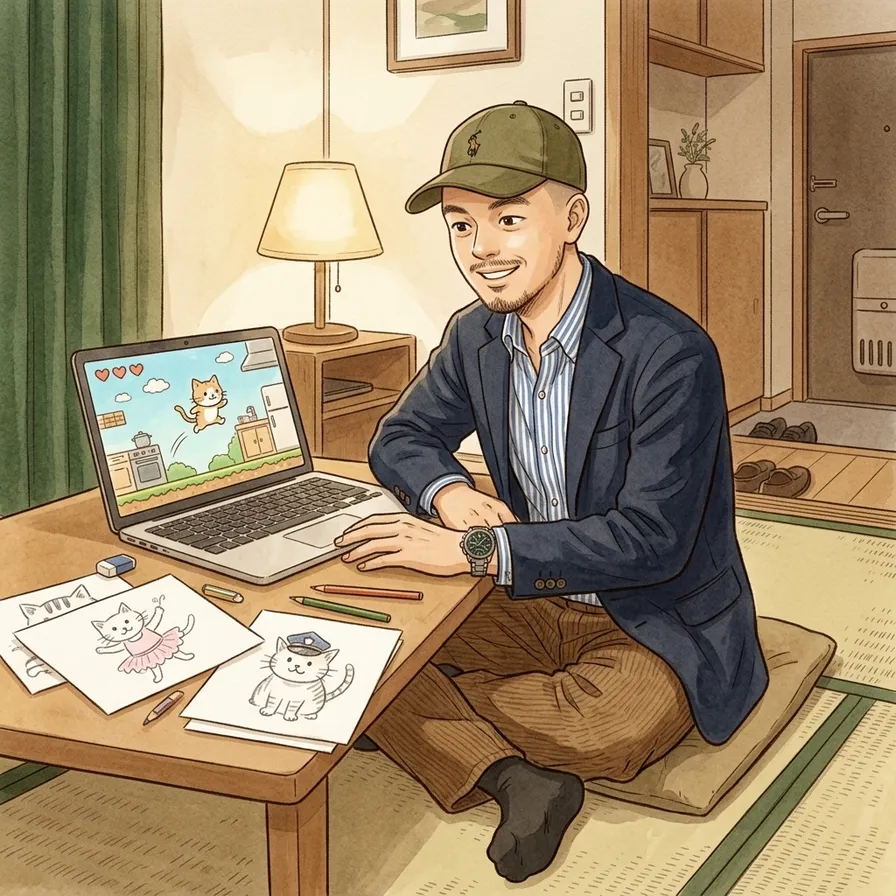
How My 5 Year Old and I Built a Game With AI
My daughter Mana is five, and one night earlier this month she was in a bad mood because I wouldn’t buy her a new toy. She wanted a Kirby game, we’d just bought Mario Party, and I didn’t want to drop another 7,000 yen, so we landed on making her own video game instead. About an hour after I started talking to Claude, she was playing it.
The video is on YouTube, and this is the build behind it.
Paw Patrol, but cats
I asked what kind of game she wanted. “Cat game,” she said, then “a rescue.” I guessed Paw Patrol and got corrected (“Not dog, it’s cat”), and when I asked about the characters she said “Draw, draw.”
Sixteen minutes later she walked me through six pages of pencil drawings. Dancing Cat, Cafe Cat and Police Cat have to catch the cat bad guy, and there’s a “cat only girl school,” a kitchen and towels where the cats sleep. I wrote what she said on each page, and that was the whole spec.
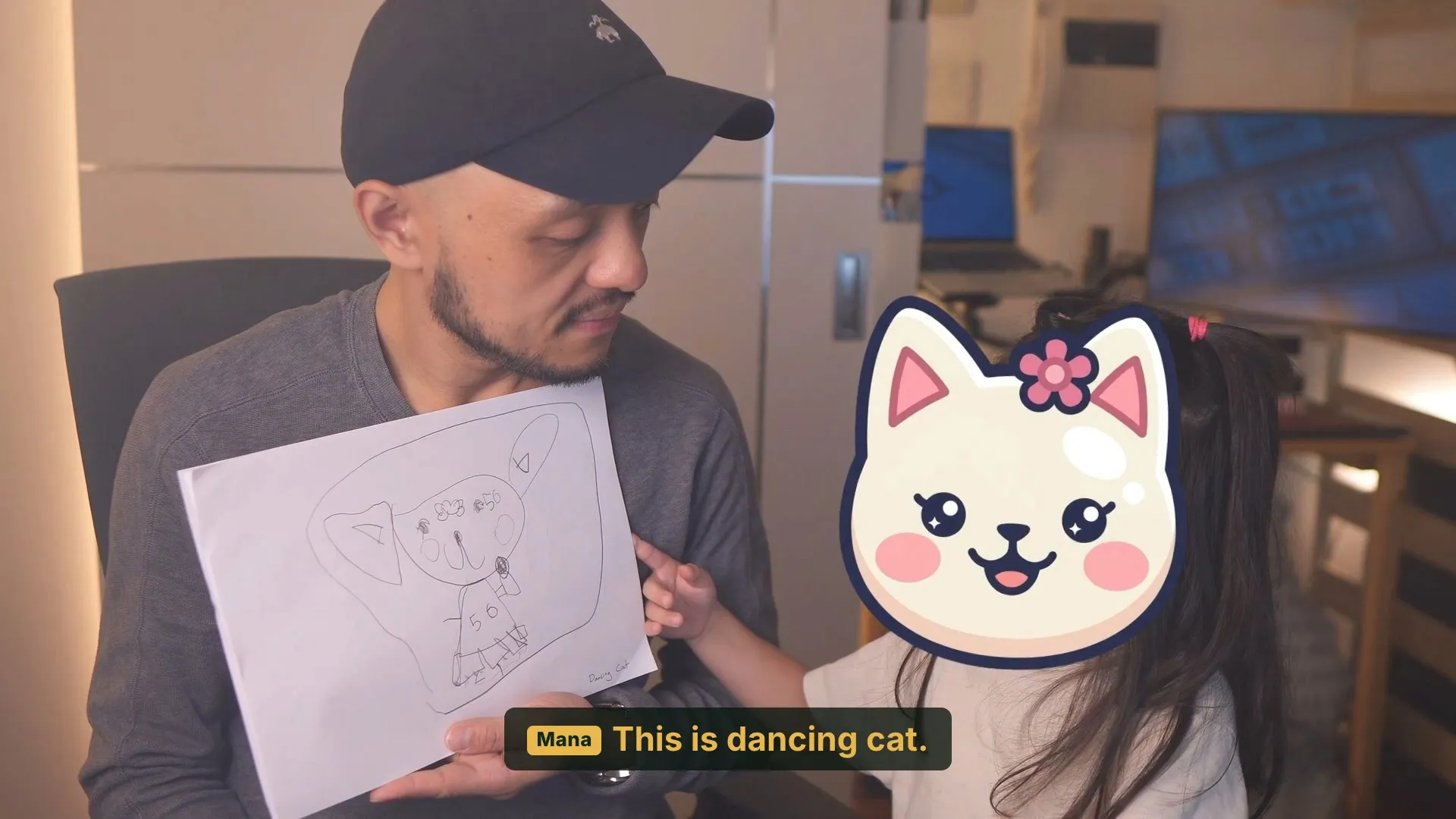 Mana explaining Dancing Cat, her face covered by the cat she drew.
The hour it took to build a game with AI
I scanned the pages, and at 21:02 I spoke one long instruction to Claude Code, an AI that writes the code while you describe what you want. By 21:41 there was a playable game, and at 21:50 I asked it to test the game.
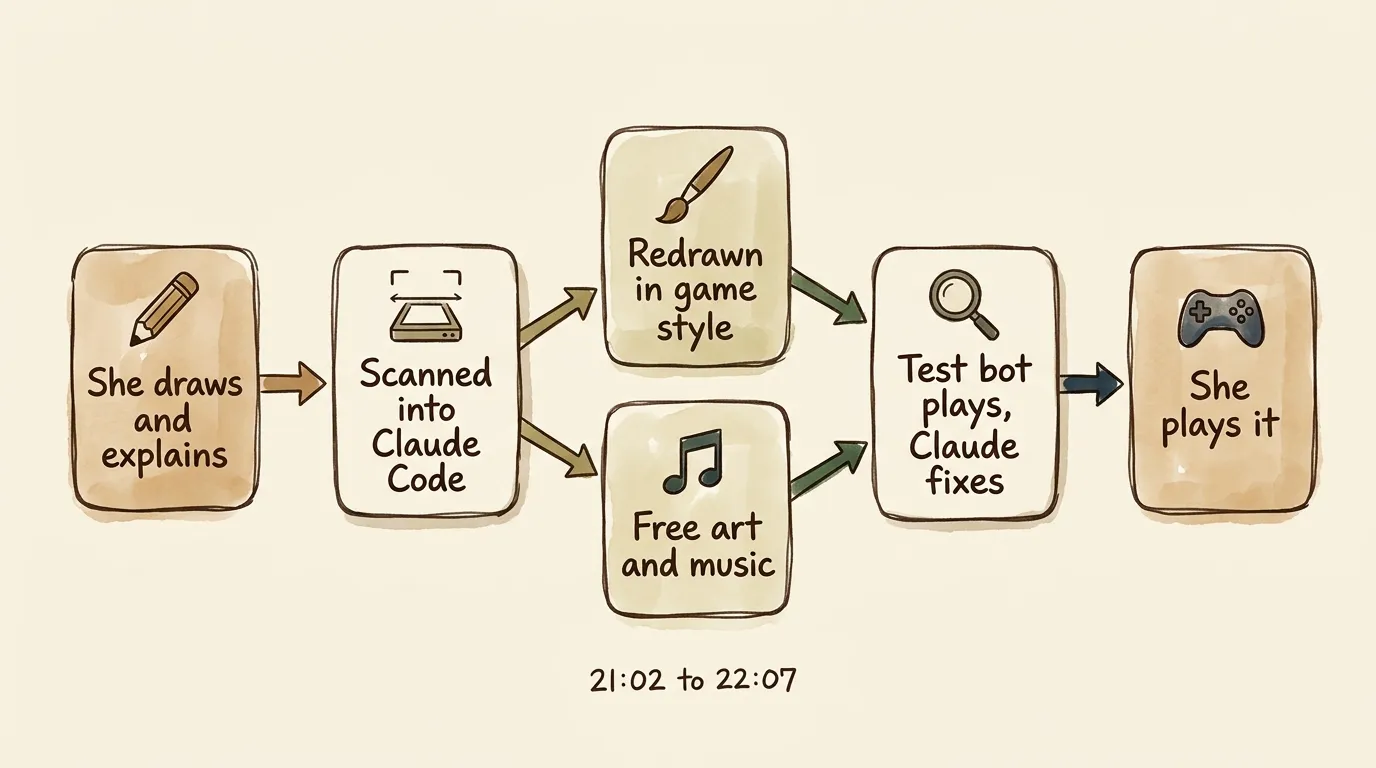 Mana did the first box and the last.
In between, Claude redrew every drawing with Google’s Nano Banana Pro image model to match free Kenney game art (the same reference image idea as my illustration system), keeping details like the 56 on Dancing Cat’s dress. It pulled free CC0 art and music from Kenney and OpenGameArt and built three levels from her places (her fridge and oven are platforms). There’s no game over, because she’s five.
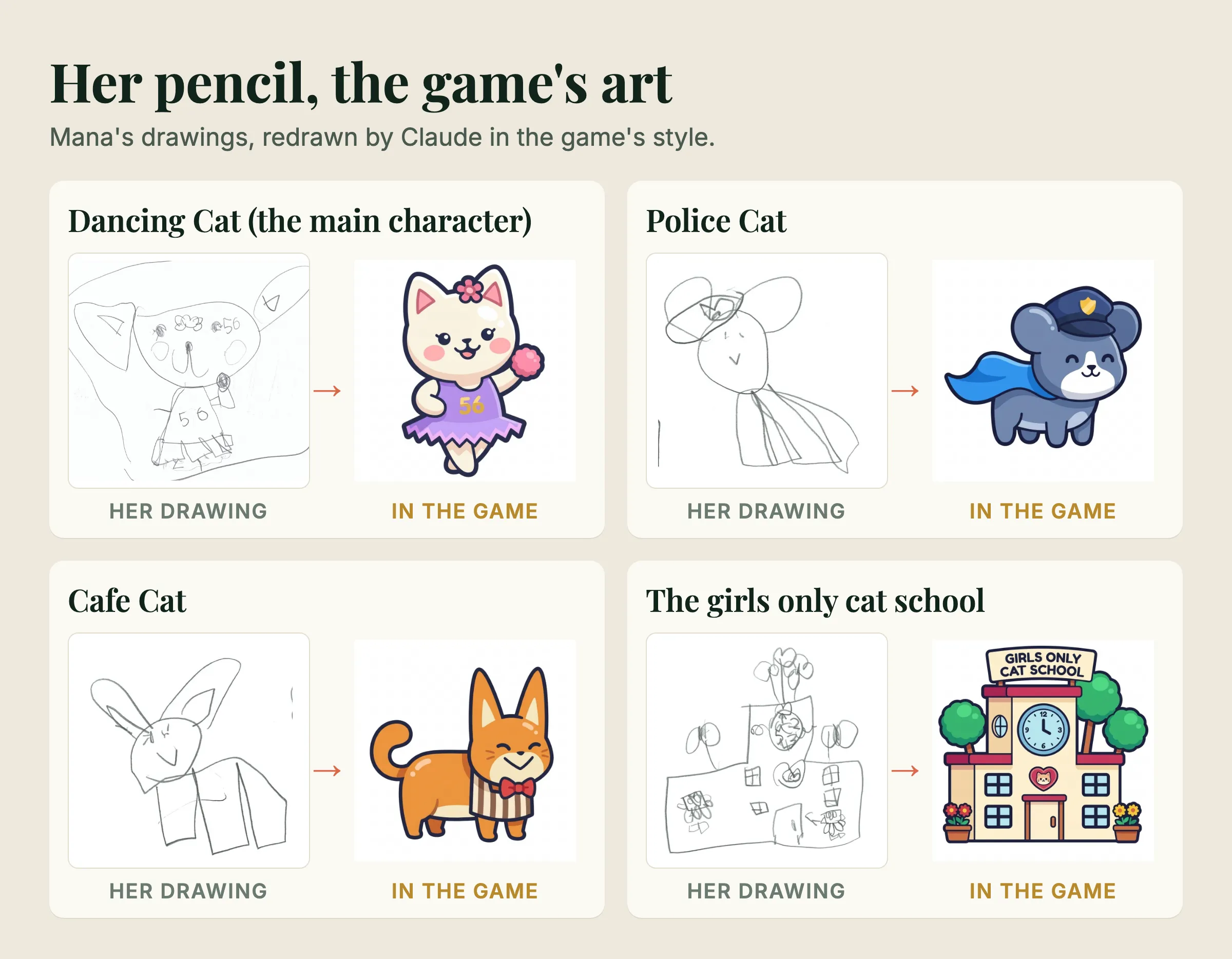 Her pencil, then the game. Each redraw cost a few cents.
That part blew me away. As I said in the video, you “don’t have to have the perfect idea or the perfect input to get something that’s workable.”
At 22:07 I said “Okay, Claude, launch the game” with Mana next to me. Her review was “Whoa. It’s so good.”
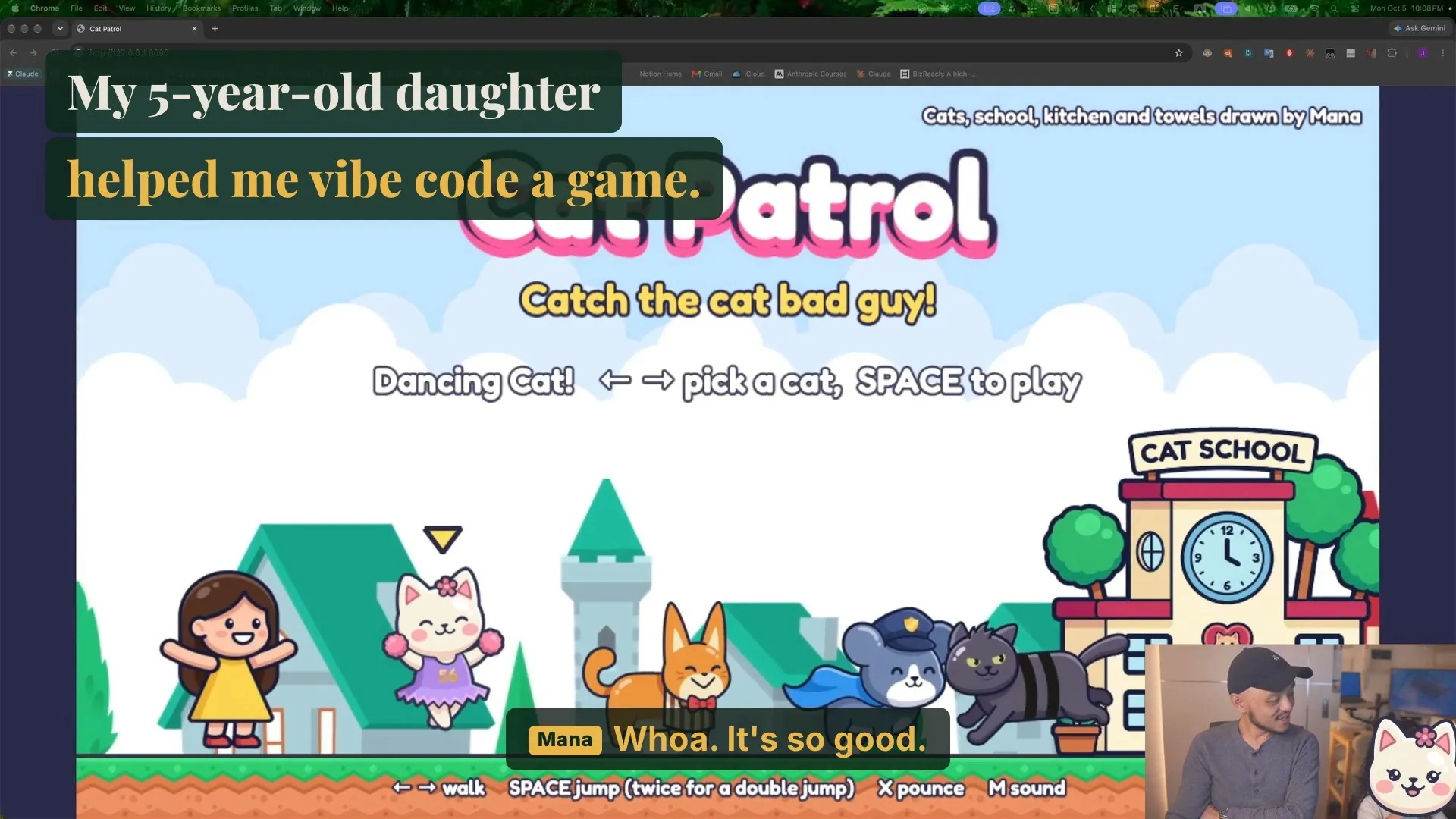 The reveal at 22:07, with us in the corner.
What I actually said to Claude
I wasn’t typing, which is why it rambles. These days I talk to Claude Code through FluidVoice, a free dictation app, because I’ve realized my typing speed is the thing holding me back. Talking naturally is easy, and Claude is smart enough to figure out what I mean.
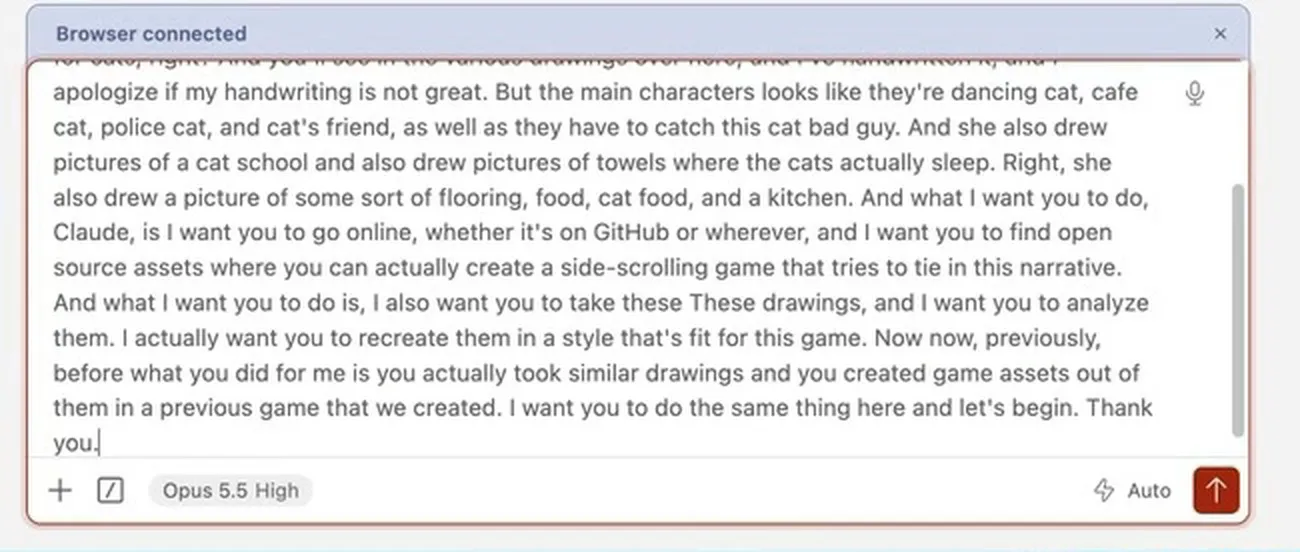 The spoken prompt in Claude Code.
Here it is in full, untouched:
Okay Claude, so what I did was I actually scanned a whole bunch of
drawings from my daughter and it should be in my scanner folder that
you always use. And what I want to do is I want to create a new game.
It's going to be the second game that we create, so please organize
this under game two under my GitHub and folder. And what the story is
is, apparently it is a story like Paw Patrol, except for cats, right?
And you'll see in the various drawings over here, and I've handwritten
it, and I apologize if my handwriting is not great. But the main
characters looks like they're dancing cat, cafe cat, police cat, and
cat's friend, as well as they have to catch this cat bad guy. And she
also drew pictures of a cat school and also drew pictures of towels
where the cats actually sleep. Right, she also drew a picture of some
sort of flooring, food, cat food, and a kitchen. And what I want you
to do, Claude, is I want you to go online, whether it's on GitHub or
wherever, and I want you to find open source assets where you can
actually create a side-scrolling game that tries to tie in this
narrative. And what I want you to do is, I also want you to take these
These drawings, and I want you to analyze them. I actually want you to
recreate them in a style that's fit for this game. Now now,
previously, before what you did for me is you actually took similar
drawings and you created game assets out of them in a previous game
that we created. I want you to do the same thing here and let's begin.
Thank you.
It has everything Claude couldn’t guess, like where the files are, the story in one line, everything she drew, and the game we made the day before as the example. I built the website you’re reading the same way.
I still don’t know how to code. You do need to know the setup around it, like what an IDE is and which model to pick, and that takes a little getting used to.
The mask she never drew
The first redraw of the cat bad guy came back wearing a robber mask, and Mana never drew a mask. The image model knows what a ‘bad guy’ usually looks like and filled it in, so Claude redrew him with only her stripes.
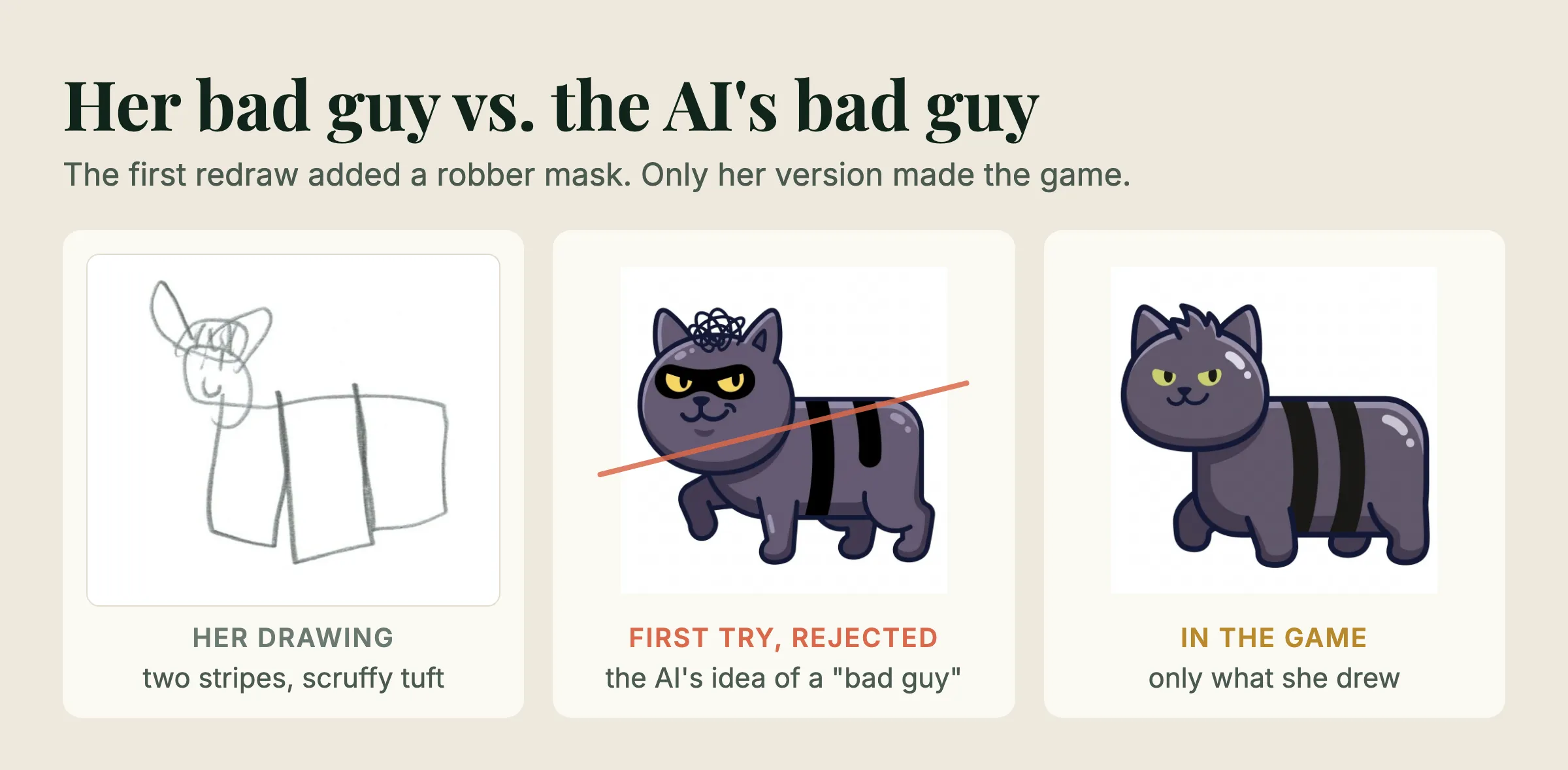 Her drawing, the rejected try, the final bad guy.
My test request was one line, and it caught a different kind of mistake.
Can you do a QA and see if the game works well. take images to see it actually worksClaude wrote a bot that played the whole game like a kid would, once with each cat. The bad guy was too fast, a quick tap barely jumped (little kids tap) and the mice were eating most of the hearts. Before the fixes the bot lost 11 hearts in the kitchen alone, and after them zero to two per level.
Both times the AI filled a gap with the average answer instead of hers.
The rescue she asked for
She asked for “a rescue” game and Claude built a chase, because nobody knows yet who or what needs rescuing. That question is still in the game’s notes, next to five round shapes on page four she never labeled. Claude left those out instead of guessing, which means this isn’t quite her game yet.
The pencil spec
A pencil spec is a rough drawing plus the person explaining it out loud, handed to an AI with three rules. Keep everything they drew, add nothing they didn’t, and turn anything unclear into a question for them. The drawing tells the AI what matters and the explanation tells it what each thing is, so anyone who can sketch a box can write one.
A manager’s whiteboard. Photograph the dashboard your team sketched and get a working page without waiting on IT.
A workshop on paper. A facilitator’s hand drawn agenda becomes a run sheet and slides. Building your own tools is what I taught the Ralph Lauren L&D team (more on how AI is changing L&D). Check your company’s security rules first.
Your kid’s next idea. The brief below covers it.
Hand your AI this brief
Paste this into your AI so it can read the story first:
I just read this article about building a video game from a child's
drawings with AI:
https://leadhuman.ai/build/build-a-game-with-ai

A non engineer built it in about an hour by talking to Claude Code.
The stack: the child's scanned pencil drawings, an image model (Nano
Banana Pro) to redraw them as game art, free CC0 game art and music
from Kenney and OpenGameArt, the Phaser game engine, and a test bot
that plays the game before the child does. If you can browse the web,
read the article first (if it won't open, carry on without it). Then
help me build my own version in three levels.

Level 1: I'll upload a photo of one drawing and tell you what my kid
said about it and how old they are. Ask me what the game is about
before you build anything. Then make a simple game as one .html file
I can open by double clicking (or show me in the chat preview). Draw
the character from my kid's actual lines, and make it work with a
finger on a tablet.

Level 2: Help me set up Claude Code and build a side scroller from all
the drawings, using free CC0 assets. Turn the places my kid drew into
the levels.

Level 3: Redraw each drawing in the game's art style with an image
model. Then have a test bot play the whole game the way a kid my
kid's age would, and fix what it finds.

Rules for every level: keep every detail my kid drew and add nothing
they didn't (no made up whiskers, tails or colors). If the game needs
something they didn't draw, keep it plain and tell me what you made
up. Keep a list of questions for my kid instead of guessing. No game
over, nothing scary, no sound unless I ask. Show me every picture of
my kid's characters before it goes into the game. Don't put my kid's
name in the game, and nothing about my kid gets published or shared
anywhere without my explicit yes.
Try level one tonight with whatever’s stuck to your fridge.
Jay Vergara is an L&D strategist and cross-cultural communication specialist based in Tokyo. He is a partner at Peak Potential Consulting and writes about leadership, learning, and building with AI at leadhuman.ai and on LinkedIn.
You might also like
How I Automated YouTube Uploads Without Writing Code
I automated YouTube uploads with Claude and Gemini. A finished video used to cost me 45 minutes of forms. Now I drop it in a folder and tap approve.

Build a 1:1 Prep Prompt with Claude
A Claude prompt that turns a 90 second brain dump into a focused 1:1 agenda. Three questions, one action item, one human opener.

How to Get AI to Draw the Same Character Every Time
I'm not an engineer. I vibe coded a system with Claude that gets Gemini to draw the same character across every blog post. Here's exactly how the conversation went.